Lanre Logan
University of Leeds
Physics with Astrophysics BSc
Read more about the course


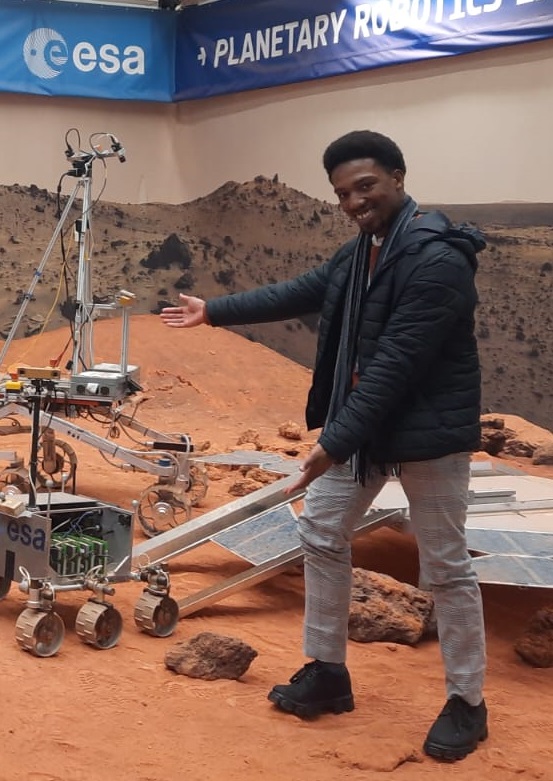
Lanre is now a Young Graduate Trainee in Systems Engineering supporting the Earth Return Orbiter at the European Space Agency based in the Netherlands. This follows his Physics with Astrophysics BSc at the University of Leeds and Masters in Space Exploration Systems at the University of Leicester. “I already had something of a space interest; astronomy, stargazing, and that sort of thing. It just seemed like an exciting aspect of physics to delve deeper into and study, and I used to always watch lots of YouTube videos describing the mysteries out there in space”.
“I was curious about working at the European Space Agency even from being in my undergrad and I saw that a masters was required. It’s been on the cards for a while! I’d applied to start the position the year before, but I didn’t succeed that time, so I applied again during my year out and got onto it! It’s essentially part of a graduate scheme called the Young Graduate Traineeship (YGT). I do systems engineering with this mission called the Earth Return Orbiter and it’s the satellite which will be flying samples from Mars back to Earth as part of the larger Mars Sample Return Campaign. I think being involved in the actual design of these missions was the thing that particularly excited me.”
“It’s originally just a one-year contract, but they can be extended, so I’ve been here for two years. They normally release calls for new positions every year across all of the European Space Agency facilities, there’s one in the UK in Oxford for instance. It’s a super international environment. I was sat with seven of the other trainees and I realized that all of us were from a different country! The official languages are English and French. And then for the Netherlands in general, almost everybody speaks perfect English too.”
“I’m London born and raised, and from London to where I’m living in the Netherlands is exactly as far as to my old place in Leeds! There is a lot of travelling back home and to international friends so I’m always packing and planning, but it is also very nice getting to experience another country, another environment. And yeah, I’ve made lots of nice friends over here.”
“It’s hard to frame the typical day because the ins and outs often change. Right now, we’re going through a review of a specific part of our mission. So, if issues have been identified I help in writing up what our next steps and action plans to rectify those will be, there could be like hundreds and hundreds, it’s all stored in online tools and excel spreadsheets, that sort of thing. Because this is my first proper role in this industry, I don’t have all the technical knowledge to actually find all these specific issues myself but this is helping to get the experience of understanding what sort of things need to be done and how they are found and then helping keep track of these. And that in general is quite a key aspect of a system engineers’ role; there’s the technical but there is sort of a project managerial flavour to it as well.”
“On the more technical side, I was developing a simulation to analyse a part of the mission where essentially the samples are launched off Mars and then the Earth Return Orbiter will have to rendezvous and capture them in orbit. I developed a simulation to analyse the idea developed to achieve this. So that was, yeah, a difficult one and fun one! It was completely computer based, so I coded this up in python.”
“I feel like I’ve been able to get involved in some key areas of mission designing. And what goes into it. And yeah, gotten a good amount of exposure and developed skills relating to that.”
“We have the option to work from home for 9 days a month, it’s very flexible. 90% of my tasks are on the computer so I can take advantage of that. It falls into that 9 to 5 structure, but then amongst this Graduate community there is an element that feels kind of university like; this big group of us in the Netherlands, there’s a big social space with sports facilities, social areas. There’s something that we call young ESA, which is essentially like a student union which organizes anything from group lunches to group trips and we have a yearly conference. And other professionals from the industry come and give talks. We have sports clubs and all that sort of thing. When you initially move, there’s a relocation service to help you find an apartment. So, it’s very welcoming, a nice place to work.”
“Overall I think it took in the order of 4 or 5 months, so yeah, it’s quite long. Like most things it just starts with your CV and cover letter. And then maybe a month or 2 later, if you’re successful, you get invited to a video interview and there’s a bit of a strange setup where you record yourself; they show the question, there’s a timer, and you can think about it for maybe a minute and then you have to record your answer. And then maybe a month after that, if successful, we were invited to the second interview, and that was face to face, there was a mix of soft skill questions as well as technical questions.”
“I’ve been very used to the university structure of you’ve got very set modules, and you know exactly how much time to spend on each one and exactly how to measure your success of that with various assessments. Whereas in this role, there’s been a lot more, I suppose, planning my tasks myself, figuring out which to do first and how to measure that it’s going OK. I think that took some adjusting for me.”
“So after the first year I applied for ESA there was some level of it being disheartening for sure but I guess it was quite early on in the final year of my studies, I didn’t feel like there was particularly too much pressure. In the year that I had off, maybe I was starting to feel a bit more pressure and bit more disheartened when rejections came. And I guess there was just some level of having to sell yourself. But yeah, you know, you have to tell yourself you’ve done well, you’ve done your best, it’ll be okay. And yeah, keep trying. I guess it’s finding the right balance of allowing yourself to, of course, be upset but then eventually pushing forwards. That was an extremely exciting day getting the good news! I had done some other applications, but this was choice number one, so that’s really nice!”
“In the Leeds Physics degree, we had the computing module and that was my first exposure to learning coding, and learning Python in particular. So yeah, that was one very essential area of study to be able to do the simulation work I do now. A lot of skills I learnt from our maths modules, for instance, were pretty integral, even like vector, calculus related things. Because, in my simulation, for instance, it’s all about analysing the position of various objects, so vectors were key.”
“I did a summer internship at Leeds, I was working with one of our professors on coding simulations analysing binary star systems. So, I think, probing the code of that and helping to test it, I think that experience definitely helped towards how well I’ve done with the simulation stuff that I do now.”
“Somehow becoming more familiar and more comfortable with planning out my tasks myself within the less structured environment would have been beneficial to me. So maybe some sort of placement or year in industry to get yourself more used to that sort of environment would be useful.”
“I think I’ll carry on in this area for sure. I’ve recently been inspired by this new technology called space-based solar power. The idea is to basically have solar farms in space. And then send the energy back down to Earth in a way that doesn’t get absorbed by the atmosphere, whereas sunlight usually does. The idea is that’d be way more efficient and help us with green energy needs”.