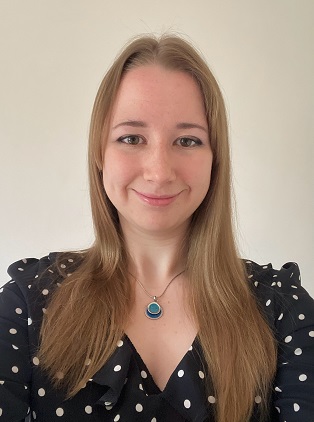
Megan Pritchard
University of York
Physics with Astrophysics
Read more about the course


Megan completed a year in industry at one of the UKRI /Science and Technology Facilities Council (STFC)’s major research and innovation campuses at Harwell near Oxford. The year in industry placement formed part of her Physics with Astrophysics degree at the University of York. Her Science Communication Industrial Placement was based in the Central Laser Facility (CLF) at the STFC’s Rutherford Appleton Laboratory (RAL).
CLF is one of the world’s leading facilities, providing scientists from the UK and Europe with an unparalleled range of state-of-the-art laser technology. The Facility’s wide-ranging applications include experiments in physics, chemistry and biology, and Megan had the opportunity to write about the real world applications of all this science. “My role also involved assisting with the Facility’s social media pages, creating resources like booklets and posters, and helping out at public engagement events. I really enjoyed the creative aspect of my placement and the variety of work I could contribute to.”
From nanoparticles in biological imaging to the climate impact of cooking oil, we explore Megan’s placement experience and some of the articles she has produced.
| Use for energy conversion nanoparticles in biological imaging – the sensitivity of nanoparticles to other variables such as pH and temperature could be investigated to tell us even more about how cells react and function, helping us to better understand the complex processes inside the body and how we can adapt our treatments for disease. Read Megan’s Article |
“My knowledge of physics from the modules I took during my degree helped me translate the technical details of the scientific papers coming out of the Facility into articles that could be more easily understood by the general public. Having that background gave me a really useful advantage when it came to putting the science first, and my love of physics motivated me to find out more first-hand from the researchers! For example, when I was writing about plasma accelerators I was able to draw on what I knew about electric fields and plasma to understand the basic concept even though it was something completely new to me.”
| Gemini uses plasma ‘optical fibres’ to improve laser-driven acceleration – this could drive a new type of X-ray free electron laser, which are currently expensive, complex, and often over a kilometre long! This new solution could be the key to a table-top version, making these high-demand machines more accessible for science and engineering. Read Megan’s Article |
“One of the more difficult articles to write was on cooking oil particles in the atmosphere. This work is predominately chemistry-based, but lasers and light techniques were used to find out more about the particles. I wrote this article very early on in my placement and it was very overwhelming to have a full chemistry article in front of me to summarise as a physicist! I quickly learnt the best way to get to grips with the content was simply to ask the researchers involved with the paper – sounds simple, but asking for help felt scary to begin with! The scientists I spoke to were always more than happy to discuss their work with me and break it down into manageable and simple sections. It was a great lesson in realising that even top-level scientists are human too.”
| What Molecular Self-Assembly in Cooking Oils Means for Our Atmosphere – Fatty acids appear to increase the longevity of pollutants in the atmosphere, and this may be crucial in helping scientists understand the effect these compounds have on air quality and our climate. Read Megan’s Article |
“Something else I learnt during my placement was just how broad physics careers span. As an astrophysics student I had never taken much of an interest in lasers before, but there is such a huge range of work that is done in that field alone, from medical research to material testing. They can even be used to explore astrophysics in the lab! There’s a growing number of research teams that bring together scientists from multiple disciplines to work on a single idea, which is really interesting to see.”
“Taking a role in communications was really beneficial to me. I was really keen to take on a role that was unlike anything else I had done and might never do again – I wanted to gain a different skillset to what I exercise during my degree to enhance my CV and gain a bit of personal development. I truly feel like I achieved that, as I learnt so many creative and artistic techniques as well as engagement and communication methods. Being based in a laser facility also meant that I was still in a scientific environment, so I was able to continue learning and consolidate my knowledge when I needed to. I was also able to network with scientists and gain some hugely valuable connections in the fields I’m interested in. And, purely from a personal aspect, I had a brilliant year meeting students from other universities, making friends, and generally exploring a new place and way of life outside of uni!”
Megan is returning to York for her Masters year. “Going back to university, I feel as though my placement has given me a great sense of perspective of what science leads to in the real world. Sometimes it can feel like what you are learning exists in a vacuum, and so it was great to see the possibilities. I would never have imaged at the start of the placement that I would be writing about mung beans!”
| A Guiding Light: The Role of Photon Emissions in Plant Development – why do mung beans, and other plants, emit more light when growing their roots, or under stress? It could be allowing the cells to instruct and listen to one another to increase the chances of the collective plant’s survival. Read Megan’s Article |
“I’ve gained a lot of skills and knowledge that I hope to apply next year, like teamworking, project management, and perseverance. One thing I really want to take away from this experience is the ability to communicate science well – I’m so passionate about sharing my love for science. When people hear and read about my final year project I hope they feel excited about it, and I hope they really understand it. My goal is that whatever I write, no matter how scientific the paper, anyone who is interested could follow it through.”
“When I finish my final year, there are two paths I can see myself taking. The first is that I go back into science communication, as I have done and so enjoyed on my placement, and the second is that I take on a PhD. I think I’d like to do both over the span of my career, and so the most logical and most likely decision is that I will do the latter first. I’m particularly interested in astrobiology – the study of life elsewhere in the universe, and the origins of life on Earth. I’d love to pursue a career in that field. As a researcher, I then hope I will communicate my (hopefully exciting) work with the world!”