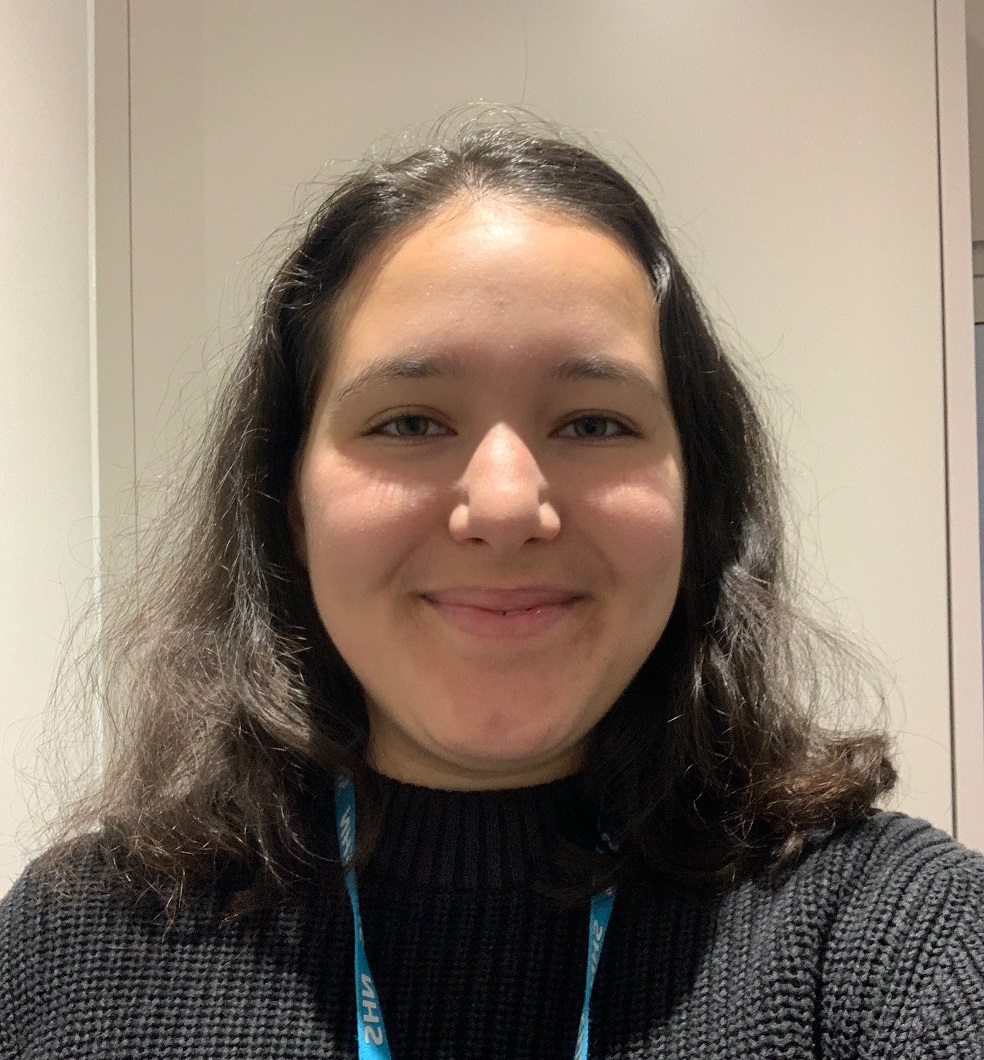
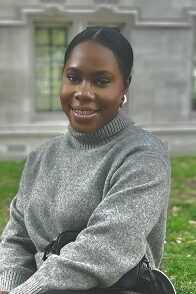
Shenade Gordon
University of Sheffield
BSc Physics with Medical Physics
Read more about the course

Shenade is a Trainee Clinical Scientist in Southampton on the Medical Physics Scientist Training Programme (STP) Equivalence specialising in Radiation Safety and Diagnostic Radiology following completion of her BSc in Physics with Medical Physics at the University of Sheffield.
“When I was in college back home in Grenada, an alumni came by to speak to my physics cohort while he was a physics undergrad at the University of the West Indies. That was a huge motivation, you know, seeing a person who sat in the same chair as me is now studying a further physics degree. I also remember doing a nuclear medicine module then and that really sparked my interest. So I did a lot of research to figure out how could I use nuclear medicine as a career and I came across medical physics and the STP.”
There are a number of routes to become a clinical scientist. “I think this route is quite new so a lot of people don’t know about it. The STP, run by The National School of Healthcare Science, is most popular and competitive but there are other routes that one can take to get the same outcome. With the STP Equivalence there are two parts: there’s the training, but there’s also the job – you’re not supernumerary. As part of my training, I’m completing an MSc in Medical Physics at the University of Surrey.”
“Every day is different! A typical day on site might include conducting an audit to ensure an area is compliant and participating in a rehearsal for a radiation incident.
I may go on to complete a dose calculation for an incident – let’s say a patient attended for a CT scan and something went wrong, the patient might have received more or less radiation than intended and we would need to determine whether this needs to be reported to a regulatory body. I may also investigate staff overexposure and many times it’s not real but because the worker travelled and their dose badge got scanned at the airport.”
“In the afternoon I may perform quality assurance tests on an equipment, for example an X-ray or phototherapy unit, and prepare a report. During the visit I may collaborate with an engineer whose done operational work on the equipment and I must test it to ensure that it’s safe to go back into clinical use. I may receive a call from sonographers reporting visible artefacts on ultrasound images. In this case I would go over with a phantom to assess the fault and decide whether the transducer can remain in use.”
“Another day working remotely, I may be presenting a research project at a multidisciplinary team meeting or reviewing a risk assessment. I may also be working on a new room design – so let’s say a new CT scanner is to be installed I would do calculations to determine how much shielding the builders should put in the walls and doors and recommend suitable positions for fixing the equipment.”
“Although I’m based at the Southampton General Hospital, my team provides services to other hospitals within and outside the Trust and to private clients. So I travel to places such as the Isle of Wight and Guernsey and I’m actually going on a cruise ship next Wednesday to test their x-ray machine! I hadn’t thought about it before, but cruise ships have a little medical centre! Other private clients I work with include dentists and vets.”
“With the STP Equivalence, it’s really up to you as a trainee when you’re ready to apply to become a clinical scientist. Whenever I gather enough evidence and put the portfolio together, once I’m happy and confident then I would submit it. But it would be let’s say within 3 to 4 years from starting.”
“I applied for the STP but I didn’t get shortlisted. I mean, like with any other disappointing news, I felt a bit disheartened at the time. I was in my final physics lecture when I got the email and I don’t think I paid attention to anything in the lecture afterwards!”
“I was really determined regardless, so even if it meant applying the next year, I would have done that. But because at the time I was an international student and finishing my course in that year, I needed to have a plan as my student visa would expire. So that’s why I thought, okay, I’ll just apply for technologist roles, and maybe the next year I can apply for the STP again, or if that employer would allow me to, I can do Route 2, which is another route. But lucky for me, in my second job application I learned that the employers were also searching for a clinical scientist, and I thought, oh, that’s what I actually want to do so I expressed my interest and they were happy to train me up. I think it’s really important to communicate what you want because I could have just kept quiet and missed the opportunity.”
“I think I prefer this route because I’m doing work as well as undergoing the training scheme. So while I was disappointed at first, things turned around, and I’m much happier now.”
“I did my degree during the Covid-19 pandemic so we couldn’t go to the hospital to do the placement module nor could I visit the Medical Physics Department to see what they do. But in 2022 when I was finally able to travel, I went home and I volunteered at a private imaging centre. I am originally from a very small island, there’s about 110,000 people and as you can imagine we have a small number and variety of medical equipment. But I thought, you know what, I’ll just make best use of the opportunity. So, I wrote to the people there. Although they don’t have clinical scientists there, they do imaging that I was interested in and I got to work with radiographers for one week. After I got the trainee clinical scientist job, I was having tea with one of my colleagues who was on my interview panel and she said that that was one of the things that really set me apart in my interview.”
“The specialism that I’m doing involves more applied physics rather than theoretical physics. I don’t have to memorise many equations for this job, especially as there are software and tools that make tasks a lot easier. But I do need to understand the physics, understand what the numbers actually mean and how this can affect a patient, for example. We support clinical workers and we have to be able to communicate with these people who aren’t physicists.”
“More than half of my course was core physics and 40% was for medical physics modules. I would say I have been using the learning from all of them actually! I learned about lasers and I now determine what eyewear is suitable for use with different lasers. When I calibrate a detector with a burnt in artefact, my learning from Solid State Physics and Electric and Electronic Circuits for example, enables me to understand what I’m doing. I see how what Biomedical Instrumentation and Tissue Structure and Function taught me is helpful. I also did Mathematics for Physicists and Programming in Python and gained problem solving skills which I apply when doing dose calculations and work in my MSc course.”
Although Shenade is training to be a Clinical Scientist, the journey doesn’t end there! “There’s quite a lot more that I can do – I’m just a trainee – and other titles that I can work towards. One of the things that I like is ultrasound, so it’s something that I’m spending time with. I attended an IPEM ultrasound workshop recently and I’m looking for other opportunities to learn more and hopefully become an ultrasound physicist. There’s also the Medical Physics Expert and Radiation Protection Adviser roles that I will consider in the future but for now I’m enjoying my training and doing my best.”
“I’d say have a goal and go after opportunities that will help you get there. But also, be patient with yourself, and if things don’t go as planned be prepared to do something else. It doesn’t mean that you have to change your destination, you can just take other routes.”