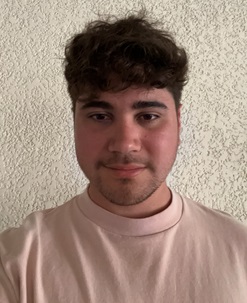
Diego Gonzalez Del Valle
University of York
BSc Physics with Astrophysics
Read more about the course


Diego completed a year in industry as a Data Scientist with SLB as part of the physics with astrophysics degree programme. SLB are a global technology company, driving energy innovation for a balanced Planet. “So I worked at the site called the Schlumberger Cambridge Research Center. It was just full of scientists which was fun!”
“You apply to loads of different placements and when I looked into this job I saw that it was data science, which is what attracted me. And especially because I could do data science in an engineering way. Also I would get the experience of working for an international company with tens of thousands of employees, that was quite exciting to be able to kind of grasp the magnitude of a real company and real business, but also at the same time working in my own scientific bubble.”
Diego’s project focused on optimising drilling, for example for geothermal wells. “Because of the very complex drilling dynamics of that process you could have drills experience shocks of up to 500G’s of force which is obviously way too much. There is a global set of guidelines to mitigate that shock, it applied to every well in the world. But you have very different geologies worldwide, so we suspected that you probably have different optimum procedures. My project was based on looking at time series data of the hundreds of sensors in the tools. I looked at the drilling parameters and the shock measurements and I created an algorithm that could detect instances where engineers were mitigating the shock by changing the parameters. We looked at different locations and found the optimum procedure for each location.”
“My job was fully programming based and office based. I was quite lucky with my manager, he gave me my own project and said to me, you can approach it in whatever way you want. And then we just had bi-weekly meetings to catch up on progress and discuss what’s next. And then it was nice, because obviously at points you do get quite stuck and in those cases you can go and ask, not only my manager, but everyone else in the team. We also had weekly team meetings where everyone discussed the progress of their projects, and then, obviously, you can give each other feedback, and share ideas.”
“My project was completely Python based, if you needed more performance for example, they have a massive computer server that you can access with like 30/40 GPU’s. Another tool we used a lot was a data science tool called Dataiku, I hadn’t heard about it before, but I found it super useful. It’s this data science web tool where you can sort of organise and automate your workflows. You can have different datasets and perform different operations, whether it’s cleaning your datasets or write python scripts with those datasets. You can do some machine learning on it too.”
“There’s about 100 people on site. And from the 100 people, I think there was 15 interns. It was really nice, because they ended up becoming actual friends, not just co-workers, so that made it a lot more enjoyable throughout the year. You have a lot of research companies in Cambridge as well, there’s a lot of placement students in general, so it’s very easy to befriend people.”
“My Python and programming skills alone have just gone through the roof! Also machine learning, I hadn’t had any experience with it before this placement at all, and I’ve had to use it quite a lot for my project, now I want to get more into it. Also, just multi objective problem solving skills.”
Diego has also developed his communication skills; “I feel like that’s something we struggle a lot with as scientists just in general, like just having to relay scientific information to non-science people. I think it helped me a lot this year to be able to do that.”
What was useful from the degree during the placement? “Mechanics helped me a lot. I would say, mostly, I feel like just a combination of all the physics theories. And then the critical thinking and problem solving skills that you get from physics. It just made it a lot easier to understand how everything worked.”
“So obviously everyone, I would say, probably every placement student experiences some sort of imposter syndrome because obviously, you have all these, like senior scientists that have been working there for years and years, or even the interns since we have some PhD students. It can be quite intimidating. And you don’t have a set of instructions to follow. You’re kind of just doing your own thing, so you think, oh, what if it’s not good enough? But, I think I was in the perfect work environment because we were treated the exact same as every other scientist in the room, and we had the same amount of input, the same amount of everything. But at the end of the day they always would remind us that even though we’re working for them, we were there to learn. So that was very reassuring that they kept laying that out. And all these people in the team were super lovely. So even if, let’s say, I was doing something wrong, it’d be them trying to offer help in a constructive way because they’re scientists and want things to go right, everyone is very constructive with everything, so that makes any imposter syndrome that you have just go away instantly.”
“You do have your own project of something that no one’s ever done before, which is very exciting. And because the scientists are really interested in it too they find it quite exciting as well. So they’re happy to help in any way they can.”
“I was very happy with the results of the project. By the end, I had a working algorithm that was able to detect these instances of mitigation. And then, based on that, I created this piece of code so that you could automatically compare the results of that algorithm to the guidelines. I have data to show it was a very effective algorithm. I wanted to set the path forward because all of these projects, they’ll get carried on by either another intern or someone at the company. And so I think, all that was really left is to just scale the project up, maybe by uploading the algorithm to the cloud so it has access to all the company databases to ingest data from +50,000 wells.”
Has the placement helped Diego decide what he wants to do in the future? “Oh, yeah, a hundred percent, so before this job I was interested in data, now I’ve completely fallen in love with data science and I am obsessed with it. Now, having done one year of it, I can confidently say that it’s what I want to do.”
Diego went straight home to Mexico following the year in industry but is still managing to squeeze in a summer placement working remotely. “I’ve already been able to improve upon parts of the project that involve programming from my experience in the year in industry.”
And would Diego recommend a year in industry? “I couldn’t see a single reason not to do it! You think about the cons, you might have some imposter syndrome, you will be far away from friends. All those things you can end up resolving quite quickly, because again, I’ve made so many new friends, I’ve found a beautiful city in Cambridge, so that’s all the stuff outside of work. And also in work, I had an amazing experience. And yeah, I learned so much, I would have never thought how much I was gonna learn from this both in the actual programming and all the hard skills. But also just having a job where you have to have meetings, have presentations, speak to different people in different positions. So you learn an insane amount. And then at the end of the day it’s a massive boost on your CV. And now, when I go into my next job, I can come in with a lot more confidence in myself”.